

Carl Grossberg
Wuppertal-Elberfeld
1894 -
Laon/Frankreich
1940
Carl Grossberg was born in Elberfeld/Wuppertal on September 6, 1894. At the age of nineteen, the artist began to study architecture at the universities of Aachen and Darmstadt. His conscription to the military forced Carl Grossberg to interrupt his studies.
In 1919 he continued to study under Walter Klemm at the "Hochschule für bildende Künste". From 1919 to 1921 he studied under Lyonel Feiniger at the Bauhaus in Weimar, where he trained in painting, decorative painting and spatial design. In 1921 Grossberg undertook extensive study trips to Southern Germany and settled near Würzburg.
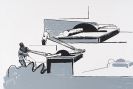
In 1927 Carl Grossberg again traveled a lot to paint his typical machine pictures, industrial landscapes and cityscapes. He began to receive more and more commissions form industry, for instance in 1932 from the Norta wallpaper factory in the Harz region and in 1937 from the baking-goods firm Oetker in Bielefeld, where he moved into his own studio. From 1933/34 Grossberg's interest in technology and industry began to assume encyclopaedic dimensions. He set himself the goal of painting the most important types of industries and industial plants in Germany, calling this undertaking his "Industrial Plan".
The Nazi regime and the approaching war lead to a dramatic deterioration in his commissions, so that he tried to use various connections in America to realize his plan. As a reserve officer, Carl Grossberg was not allowed to leave the country and therefore was not given permission to travel to the US in 1939. That same year, Grossman was called up for active duty.
Those last years left him virtually no time to paint, so that even his last watercolor remained unfinished. Carl Grossmann died in a tragic car crash in the forest of Compiègne near Laon on October 19, 1940.



Would you like to sell a work by Carl Grossberg?
Infos for seller


Starting bid: 4,500 EUR